

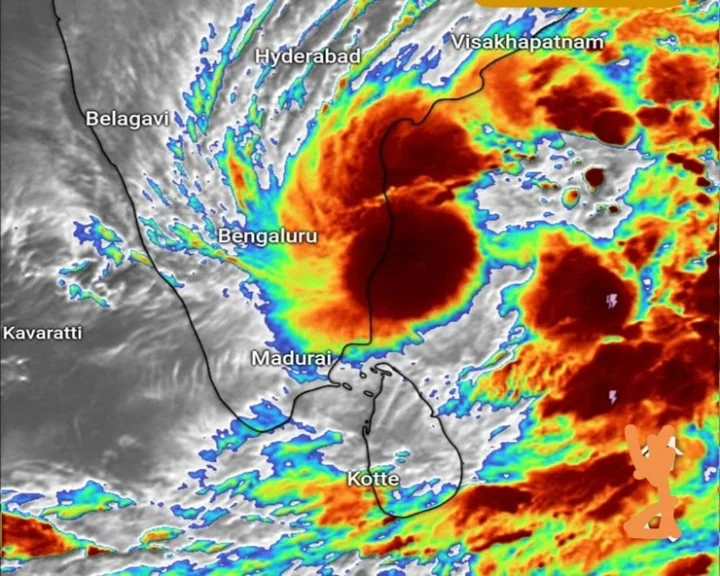
Updated: 12:28 a.m. IST, November 3, 2026 | New Delhi: Severe Cyclonic Storm Murasu was positioned just off the south Andhra Pradesh coast late Monday, with the India Meteorological Department (IMD) forecasting a crossing between Nellore and Narsapur during the night and early hours of Tuesday.
The latest IMD sea-area bulletin available to this update was issued at 11:03 p.m. IST on November 2 and is valid through 11:30 a.m. IST on November 3. It said that at 8:30 p.m. IST on November 2, the storm’s centre was near 14.9°N and 80.6°E — about 60 km east of Kavali, 80 km northeast of Nellore, 90 km southeast of Ongole and 160 km south-southwest of Machilipatnam. The system had moved north-northwestwards at around 12 kmph during the preceding six hours.
Landfall window and wind warning
IMD forecast that Murasu would continue moving north-northwestwards and cross the south Andhra Pradesh coast between Nellore and Narsapur, close to Ongole, between 11:30 p.m. on November 2 and 4:00 a.m. on November 3. The forecast intensity at crossing was sustained winds of 100–110 kmph, with gusts up to 120 kmph.
Important: At the time of this update, the latest bulletin cited here described landfall as expected; it did not confirm that the crossing had already been completed. The timing and intensity can change, so readers should check fresh IMD and district-administration updates.
Rain and safety precautions
Heavy to very heavy rainfall is expected in parts of coastal Andhra Pradesh and Rayalaseema, while warnings also cover adjoining areas of Telangana, Tamil Nadu and other east-central states. Rough seas and strong coastal winds can disrupt fishing, transport and power services.
Residents in low-lying and vulnerable coastal locations should follow evacuation or shelter instructions issued by local authorities. Fishermen should remain ashore during the warning period. Avoid beaches, flooded roads, fallen power lines and damaged structures.
Sources and updates: India Meteorological Department sea-area bulletin (issued 11:03 p.m. IST, November 2); The Economic Times weather update; NDTV report citing IANS.